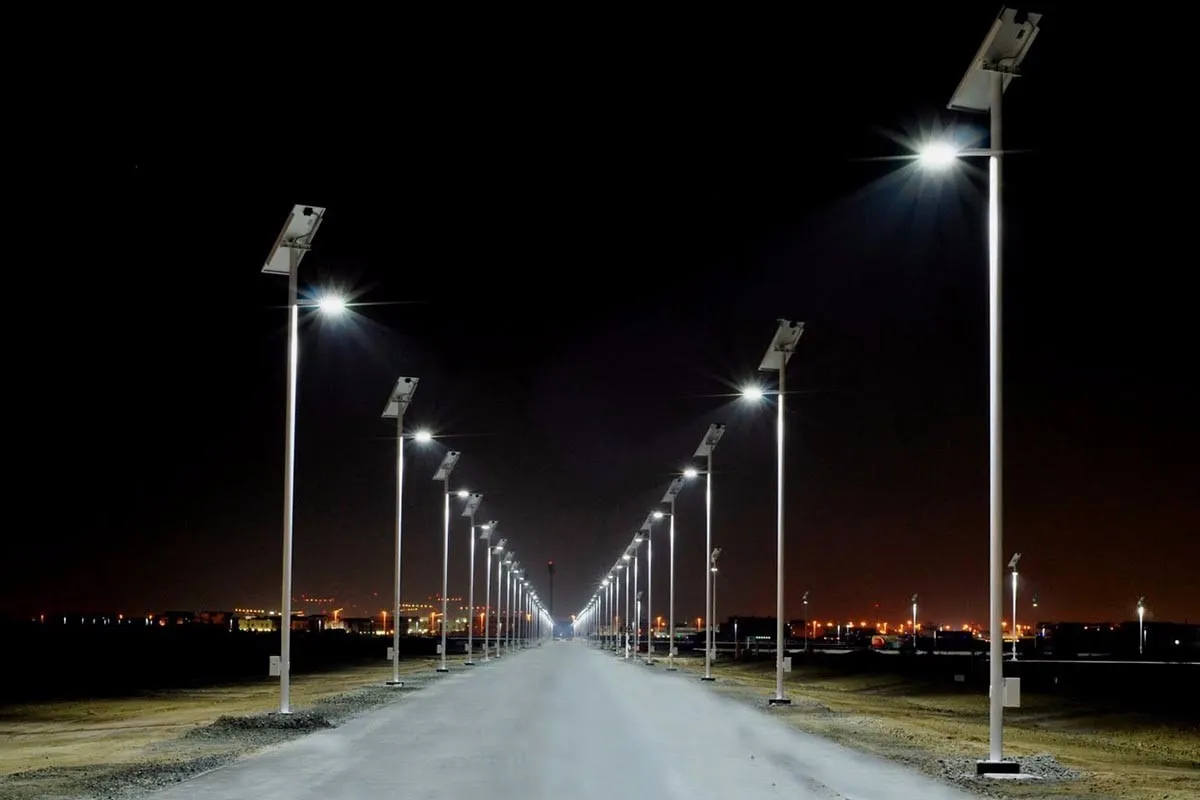
One of the critical parameters directly affecting urban safety and driving comfort is the accurate determination of the distance between street lighting poles. On highways where car headlights alone are insufficient, ensuring homogeneous light distribution improves night vision for pedestrians, cyclists, and drivers, reducing the risk of accidents. When starting the design, variables such as road class (M1–M6), pavement reflectivity, pole height, and luminaire light distribution are all included in the equation. Due to this multi-variable structure, the distance between street lighting poles yields the most efficient result when determined through engineering calculations rather than as a single fixed number.
The generally accepted approach is to keep the distance between poles in the range of 3–4 times the pole height; however, this ratio is only a reference. For example, a wide-beam (60°) LED luminaire mounted at a height of 10 m can provide a homogeneous road brightness of 1.0 cd/m² over a distance of 30–35 m, while a narrow-beam (30°) optical luminaire at the same height reduces the distance between street lighting poles to 24–26 m. Additional poles may be required at sidewalks, medians, and intersections to prevent sudden patches of darkness.
The most critical data used in photometric calculations is the luminaire's IES/LDT file. The ratio of the lowest road illumination level (E_min) to the average level (E_avg) should not fall below 0.4; otherwise, drivers will experience glare and contrast perception will decrease. CRI ≥ 70 LED chips adequately support color recognition, while a 4000 K color temperature offers the most comfortable perception during the scotopic-mesopic transition of the human eye. IP66/IK08 protected housings ensure a long lifespan against rain and impacts; furthermore, the anchor plate with a 10% horizontal tilt tolerance facilitates the pole's upright position on road slopes.
For energy efficiency, photovoltaic-assisted or dim-to-off controlled systems can be used. Smart drivers reduce watt consumption by 50% by lowering the current when traffic density decreases after midnight. This increases LED lifespan and reduces maintenance frequency. Ossam Lighting engineers prepare project-specific Dialux calculation files, presenting light level, glare, and uniformity criteria in a single report; the operator effortlessly approves the correct pole height and distance between road lighting poles combination. Furthermore, on-site lux measurements are compared with digital twin data to confirm the accuracy of the installation; this service reinforces the Ossam Lighting guarantee.
As a result, the optimized distance between road lighting poles increases driving safety, reduces light pollution, and lowers energy costs. When accurate calculations, high-quality luminaires, and intelligent control are combined, both user satisfaction and sustainability goals are met simultaneously.
Tags: