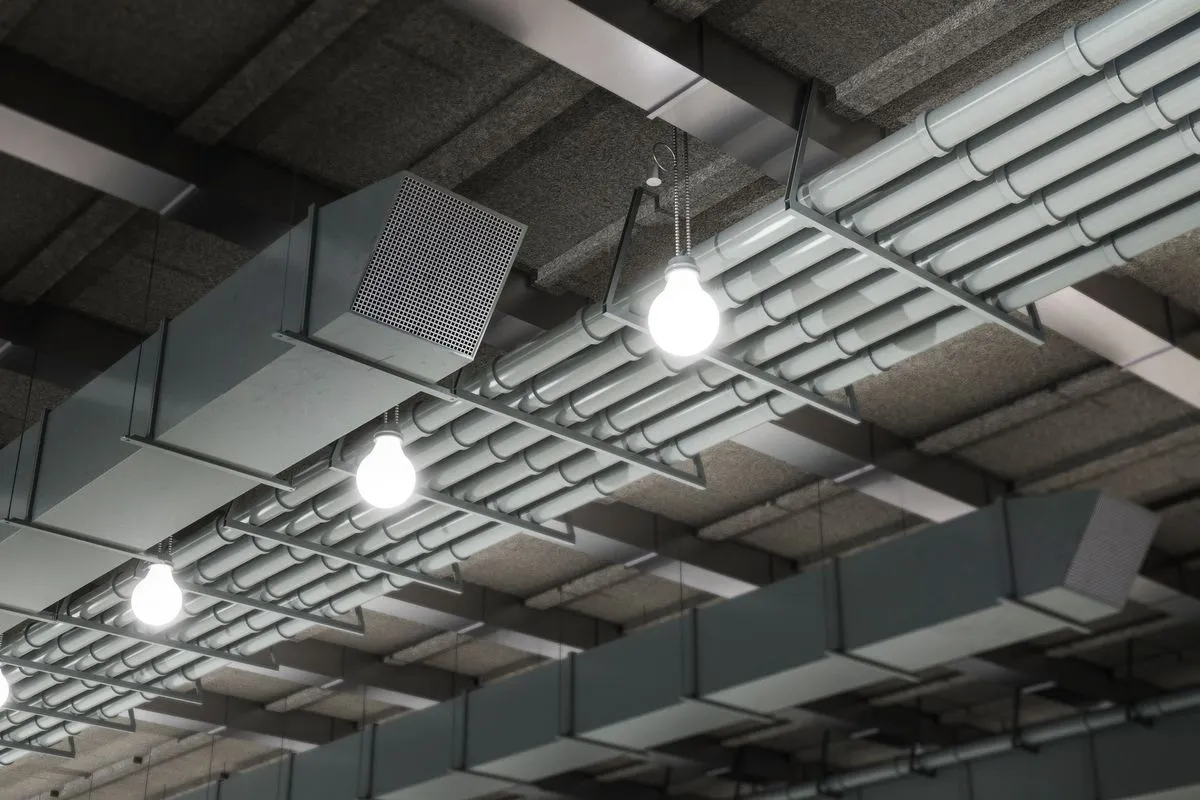
By eliminating cable clutter in electrical infrastructure and combining energy and flexibility in a single profile, Lighting Busbar Systems have become the backbone of modern industrial and commercial projects. Developed in the 1980s as an alternative to traditional cable trays, this rail-type transmission line is now used in a wide range of settings, from factories and warehouses to logistics centers and art galleries. The basic principle is to assemble multi-core copper or aluminum conductors in slots created by extrusion within an aluminum housing. This combines both mechanical support and electrical supply in the same structural element; time-consuming tasks such as cable stripping, clamping, and spiraling become a thing of the past.
The installation process is simple: suspension rods are fixed to ceiling joists with chemical anchors or flange brackets; then the busbar is mounted on a rigid suspension rod or steel cable. Even with laser leveling along the line, deflection differences remain at the millimeter level over a 50-meter stretch. The most common current ratings for lighting busbar systems are 25 A, 40 A, and 63 A; however, in high-ceiling warehouses, it is possible to provide solutions up to 100 A with purity-enhanced copper strips. Four conductors can be carried on a single line: phase-neutral-ground-control; six conductors can carry three phases plus a dimming/DMX line or an emergency line on the same rail. Thus, a single profile functions as a complete power backbone.
The low impedance of copper conductors reduces the voltage drop at the end of the line to below 1%. This allows LED luminaires to operate at the driver current specified in their datasheets, without fluctuations in color temperature and luminous flux. Thanks to its narrow cross-section aluminum housing, lighting busbar systems act as a natural heat sink; even in lines with continuous current flow, the conductor temperature remains well below the IEC 61439-6 standard. The use of LSZH (Low-Smoke Zero-Halogen) compound for insulation prevents the formation of black smoke and toxic gases in case of fire; visibility of emergency evacuation corridors is maintained.
Modularity is the greatest gift this system offers to designers. Complex ceiling geometries are effortlessly configured thanks to L, T, and X junctions. 1-meter blind plug profiles eliminate "dead lines" in sections where future expansion is anticipated; the system can be extended simply by adding new rails when the project grows. Luminaire adapters – narrow-body spotlights, high-bay floodlights, linear flush lights, or pendant lights – are installed in seconds using a special locking mechanism in the rail channel. Therefore, there is no need to run cables when there is a change in shelf placement, production line, or exhibition layout; the luminaires are simply slid into the new position and continue to operate when the adapter pin is locked.
In smart buildings, gateway modules connected to a DALI or KNX network assign unique addressing to each adapter. Thus, hundreds of luminaires powered via Lighting Busbar Systems can be dimmed in groups or scenes from central automation software. Energy management software monitors instantaneous power consumption on a line segment basis; maintenance teams can see which drive has failed on a map. This reduces operating costs and minimizes downtime.
Material selection also reinforces environmental sustainability. 95% recycled aluminum is used in the housing; plant waste is directly reintroduced into the remelting cycle. Ossam Lighting's R&D team provides maximum corrosion protection to the housing with its patented double-layer anodization + electrostatic powder coating process; this ensures the profile maintains its brightness for years without tarnishing, even in the salt-humidity combination of coastal areas.
After assembly tests, mechanical strength (< 3 mm sag at 5 m suspension spacing), electrical infrared scanning (< 40 °C increase at conductive junctions), and ground continuity (< 0.1 Ω) are measured to guarantee a long service life. The only maintenance required during operation is a visual inspection once a year and IR thermography every five years to check the connection points.
In conclusion, Lighting Busbar Systems are indispensable in any project that wants to say goodbye to cable clutter, increase energy efficiency, and provide unlimited flexibility in lighting design. Structures that choose this advanced rail system will have a seamless, safe, and scalable infrastructure for decades to come, with the assurance of Ossam Lighting. Thus, Ossam Lighting once again elevates its name to the top with solutions that bring together the concepts of power, aesthetics, and sustainability in a single profile.
Tags: